 BoxDiegen
· Burger Box
BoxDiegen
· Burger Box
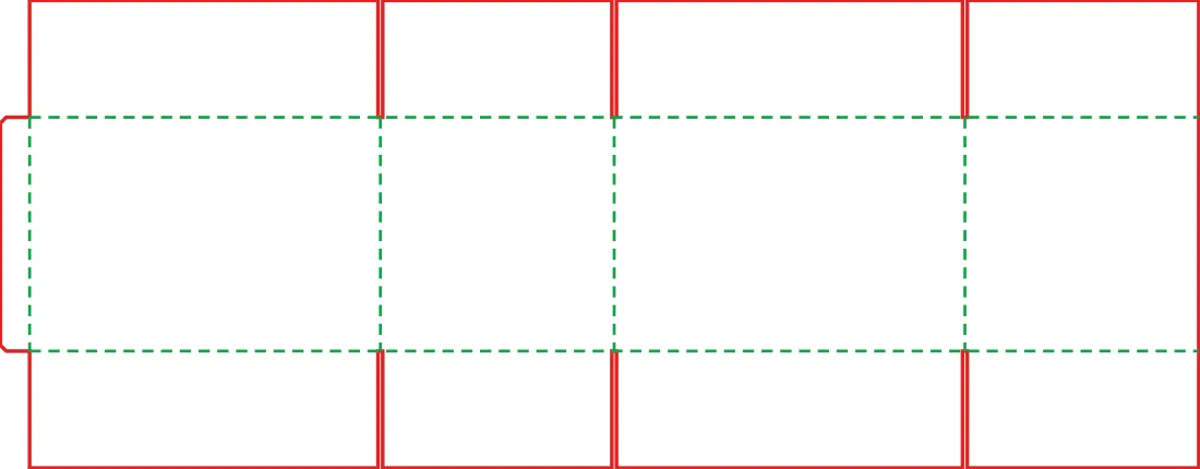
Carton Box is the regular slotted shipping carton: four panels and a glue flap form a tube, and four flaps at each end close it — the outer pair meeting in the middle under a strip of tape. Every flap is half the box width deep, and narrow slots separate the flaps at the joins. This generator draws the complete blank to your size, ready for corrugated board.
This generator makes the regular slotted carton — the standard shipping box with four flaps on top and four on the bottom (the style catalogued as FEFCO 0201). Enter your size and download the dieline free as PDF or SVG.
It is the box almost everything ships in. Four panels wrap into a tube joined by one glued flap. At each end there are four flaps: the two inner flaps fold across first, then the two outer flaps fold over them and meet exactly in the middle, where a strip of tape closes the seam. Every flap is half the box width deep, which is why the outer pair meets edge to edge with no gap and no overlap.
Because the blank is one flat sheet with straight cuts and a few narrow slots between the flaps, it is the cheapest strong box to produce in quantity, and it stores and ships flat until the moment it is packed. If your box will be glued on a machine or by hand and taped shut, this is the pattern you want.
Length (A) is the longer side of the base, Width (B) is the shorter side, and Height (C) is how tall the box stands. Depth is the inside drop from the top rim to the floor — what decides whether your product fits standing up. When you size a box for a product, measure the product, add a little padding room, and enter those numbers with the Inside size toggle on.
A is the length, B is the width and C is the height of the finished box.
| Size (A × B × C) | Typical use |
|---|---|
| 9.8 × 7.9 × 7.9 in (250 × 200 × 200 mm) | Small parcels, books and electronics |
| 11.8 × 7.9 × 7.9 in (300 × 200 × 200 mm) | Everyday e-commerce shipping carton |
| 15.7 × 11.8 × 11.8 in (400 × 300 × 300 mm) | Bulk stock, appliances and multi-item orders |
| 23.6 × 15.7 × 15.7 in (600 × 400 × 400 mm) | Large moving and storage carton |
The four panels are your print faces — shipping marks, branding and handling labels go there. Keep print clear of the glue flap and the flap fold lines. Score every fold before assembly; corrugated board only folds neatly along a proper crease. Tape belongs on the centre seam where the outer flaps meet, top and bottom.
In the exported file, red is the cut line, green dashed is a fold and blue dotted is a perforation. Print at 100 percent scale and test-pack the real contents before ordering a batch of board.
Why do the flaps all have the same depth?
Every flap is half the box width (B) deep. The outer flaps fold across the width, so two halves meet exactly in the middle. The inner flaps use the same depth, which keeps the blank a simple rectangle with slots — cheap to cut and easy to fold.
What are the narrow gaps between the flaps?
They are the slots that separate one flap from the next at each panel join. Without them the flaps would be joined at the corners and could not fold independently.
How is this different from a mailer box?
A mailer folds into a self-locking box with a lid, suited to presentation. A carton box is the plainer, stronger shipping pattern: a glued tube, flaps and tape. Most courier parcels travel in this style.
Is this carton box dieline generator free?
Yes. It is free, with no signup and no download limit. Generate any size and export it as PDF or SVG.